The Future of Anti-Piracy: How AI Agents and Human Expertise Work Together
Automatic content recognition is reshaping anti-piracy. In early 2025, a 12-second leak hit 18 000 views in under 25 minutes. A detection agent flagged it instantly; a takedown agent built the evidence and filed removal requests. With oversight from training teams, the case was closed before recommendations kicked in. This is what modern protection looks like.
Why the Old Playbooks Struggle
DRM and basic watermarking protect distribution, but once a screen is captured, redistribution is a different game. Short-form edits, mirrored live feeds, and AI-based transformations travel faster than manual review cycles. Global piracy traffic has climbed to eye-opening levels, and short video formats compress the time window between first upload and viral spread.
Simply put, automation delivers speed – and expert oversight keeps it accurate and compliant.
What Is Automatic Content Recognition (ACR)
Here’s the definition in practical terms: ACR identifies video or audio by comparing incoming signals to reference fingerprints generated from your originals.
Because those fingerprints are mathematical, they survive resizing, cropping, and many edits.
ACR technology works as an ecosystem:
Under the hood, the technology pieces work together:
Digital fingerprinting creates unique signatures for each asset.
Invisible watermarking (optional) traces the exact leak source.
Matching engines compare detected fragments to the protected library at scale.
AI Agents coordinate scanning, evidence building, and escalation.
Real-world examples
OTT platforms monitoring restreams, social networks screening uploads pre-/post-publish, and broadcasters catching mirrored live feeds within seconds.
AI Agents Reinvent Piracy Response
Unlike static tools, AI Agents act the moment a suspicious signal appears.
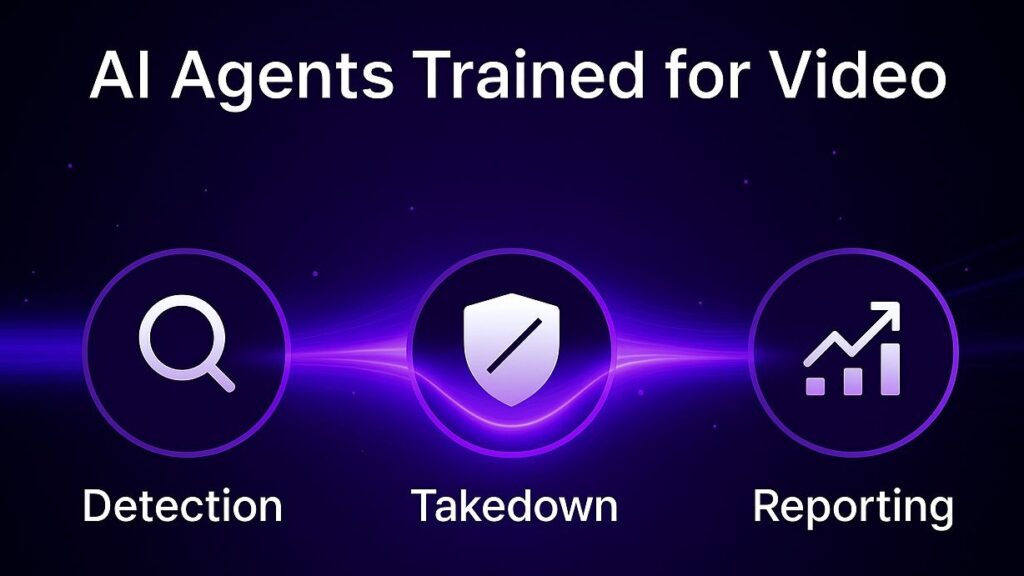
Detection Agent – continuously scans UGC platforms/CDNs and prioritizes high-risk matches.
Enforcement Agent – compiles logs, screenshots, and hashes, then files takedowns via DMCA, APIs, or trusted channels – without human delay.
Reporting Agent – consolidates results into legal-ready case files and exec-level dashboards.
AI Training Teams (oversight) – audit edge cases, tune thresholds, and handle nuance (fair use, licensed excerpts). Agents ensure speed; experts ensure legality.
A Hybrid Workflow That Scales
Signal detected → fingerprint match. ACR flags a fragment; the detection agent raises an alert.
Evidence chain. The enforcement agent assembles metadata, timestamps, and optional watermark reads.
Action. Automated platform submissions or escalations.
Feedback. Resolved cases feed model training where analytics sharpen precision and reduce false positives
Market Shift and Adoption
The ACR market is expanding rapidly as short-form, live, and AI-edited video explode. Major media companies are standardizing on agent-driven detection because it cuts response times from hours to minutes while keeping compliance intact.
Key KPIs to Watch
Time to First Sighting (TTFS): how quickly leaks are detected – target: < 5 minutes
Agent response latency: time to file a takedown – target: < 60 seconds
False positive rate: match accuracy – target: < 1%
Revenue impact: value recovered – target: tracked monthly
💡Tip: Monitoring TTFS per platform often reveals which sources need tighter watchlists before major releases.
Why WebKyte’s Approach Works
WebKyte’s AI Agents combine detection, evidence, and enforcement in one flow; AI Training Teams validate edge cases and keep signals defensible.
The result is scalable protection across UGC platforms, OTT services, and live events – without trading speed for precision.
Piracy isn’t slowing down – but your response can be faster, smarter, and more defensible.
Automatic content recognition for discovery, AI Agents for action, and expert oversight for assurance – that’s the model that works in 2025 and beyond.
📨 Want to see this pipeline in your catalog?
Request a demo and watch WebKyte’s agents trace, detect, and remove illegal content in real time.



Comments